
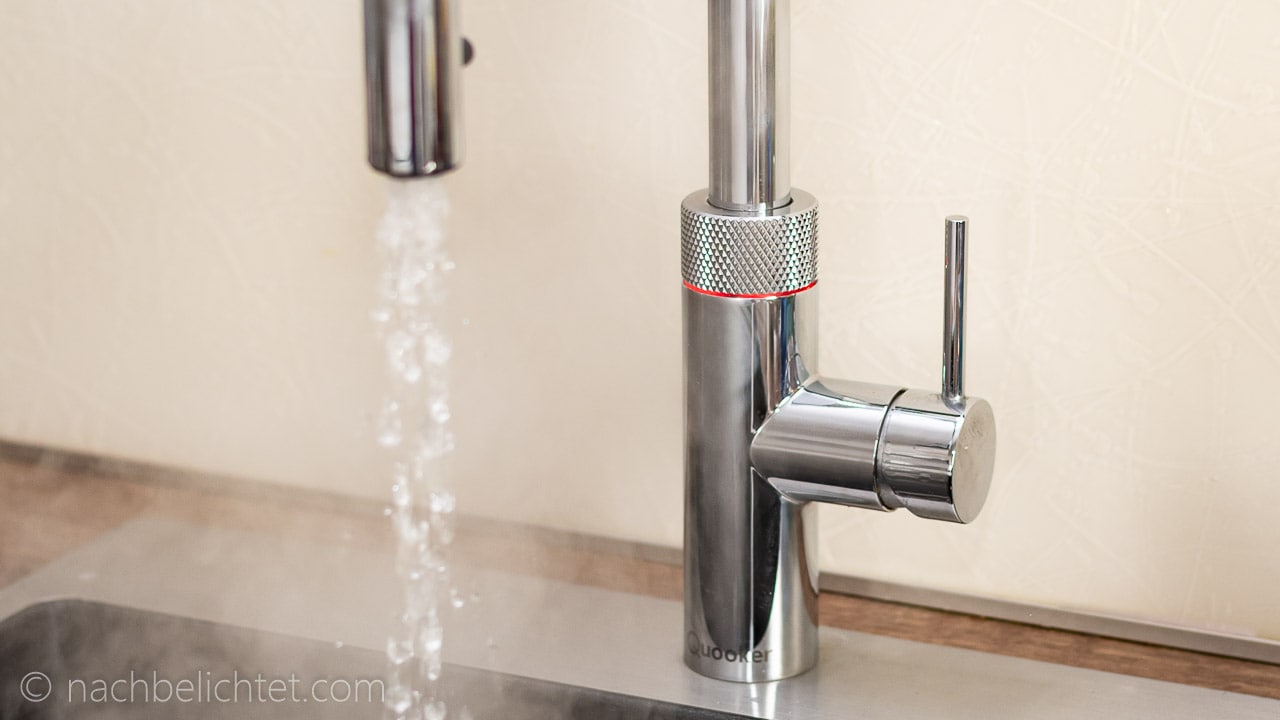
The Quooker tap is one of our best pieces of kitchen equipment (Quooker experience report and test). We use it every day and the range of applications is growing all the time. I love using wooden boards and with the boiling water from the Quooker you can clean them hygienically and quickly without detergent. Washing-up liquid is bad for wooden boards in that the wood and therefore the cut food can take on the odour and taste. As the service water in consumption-optimised heating systems often comes out of the tap at only 50-60 °C (often even lower with heat pumps), really hot water is essential in the kitchen. This is especially true when processing poultry.
However, there are strange myths and rumours about the Quooker’s power consumption. On Amazon in particular, there are some reviewers who have most probably never seen the Quooker up close, but warn of enormous consumption and compare the Quooker with instantaneous water heaters. This shows that the principle has not been recognised. I am annoyed by such unqualified comments that are completely made up out of thin air, but that’s the way it is today with “perceived facts” and opinions. Often it’s also because many people simply can’t calculate consumption, kilowatt hours and actual costs. So 2000 watts sounds like something that costs a lot of money and the power consumption of hoovers is criticised. But it doesn’t matter whether I use 2000 or 1800 watts for 10 minutes a day – with daily use, that’s a difference of 3.25 euros per year. Just for the sake of argument …
The principle of the Quooker
The main component of the Quooker is a reservoir with vacuum insulation. It is therefore an extremely well insulated thermos flask, if you like. This means that the hot water stays hot even without a constant supply of energy. In addition, the water in the reservoir is slightly pressurised so that it reaches a temperature of 110 °C. This means that you really do get boiling water at 100 °C at the tap. With a kettle, the water quickly cools down to 95 °C or less after switching off.
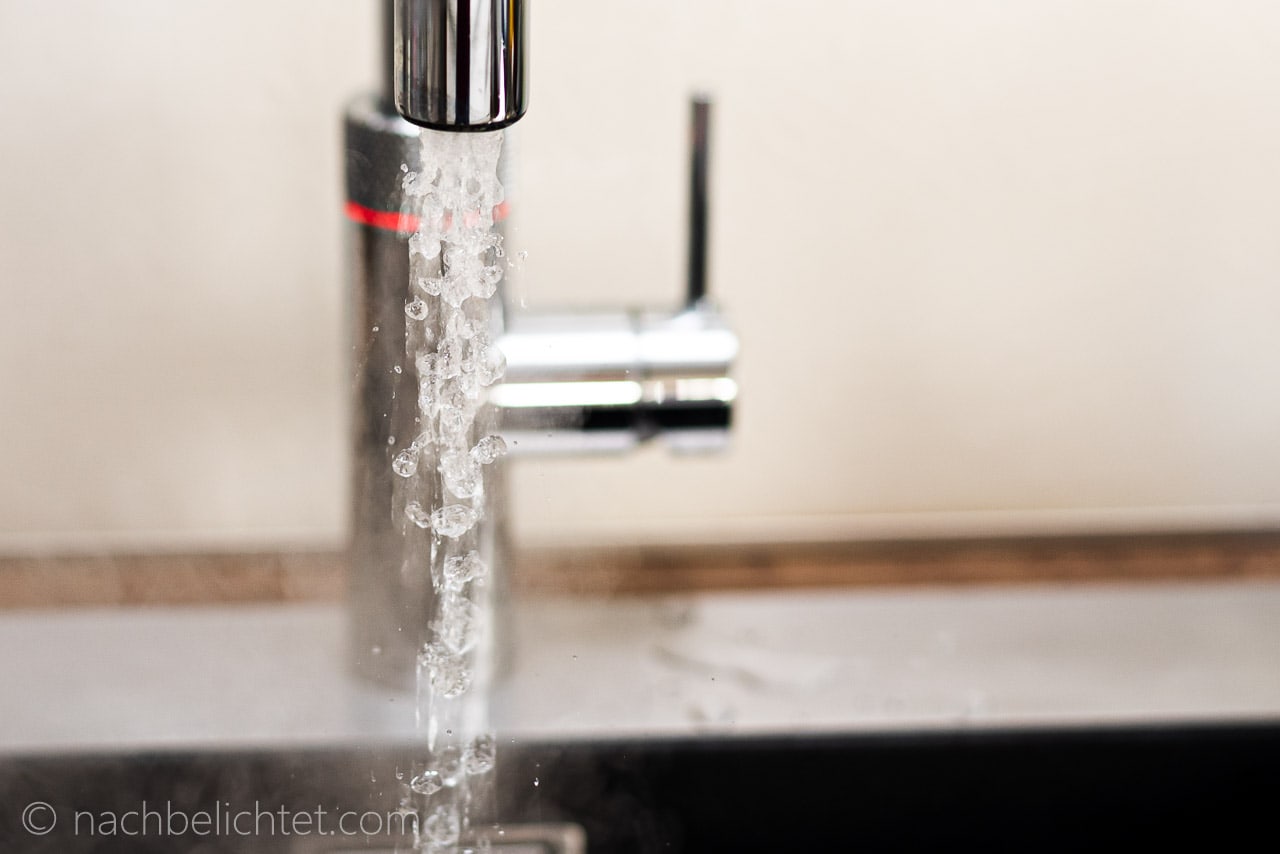
A second major misconception is that it is easy to scald yourself with the Quooker and that it is dangerous for households where children live. To remove the boiling water, the ribbed ring must be moved downwards twice in quick succession and then immediately turned to the right. It is therefore not possible to accidentally turn on the hot water. In addition, the water does not escape as a compact jet, but in droplets, which minimises the risk of scalding.
The metal of the tap is also insulated and hardly heats up when the water is drawn.

- immer kochendes Wasser zur Hand
- gekühltes sprudelndes und stilles Wasser zu zapfen
- Wassersparend
- Sicher
- Energiesparend

- Einhandbedienung
- sofort kochend Wasser
- sprudelndes kühles Trinkwasser
- ausziehbarer Schlauch

- Kochendes Wasser direkt aus dem Hahn
- Sprudelndes gekühltes Wasser direkt aus dem Hahn
- Kindersicheren Bedienknopf und einen doppelwandigen Hahnauslauf

- 100°C kochendes Wasser
- Gekühltes sprudelndes und stilles Wasser
- Energiesparend
- Platzsparend
- Nachhaltig
- Quooker PRO3 & CUBE | Flex RVS (komplett aus Edelstahl gefertigt) inklusive Würfelfilter

- 3-in-1 Küchenarmatur – Kochend heißes Wasser (100°C), gekühltes stilles Wasser und sprudelndes Wasser jederzeit direkt aus einem Hahn. Flexibler Zugauslauf – Praktischer Schlauch für mehr Reichweite und Bewegungsfreiheit beim Spülen und Befüllen von Gefäßen. Modernes Square-Design – Geradlinige, elegante Form für eine stilvolle und zeitlose Küchengestaltung. Sicher & energiesparend – Innovative Quooker-Technologie schützt vor Verbrennungen und reduziert den Energieverbrauch. Maximaler Komfort im Alltag – Ideal für Tee, Kaffee, Pasta, Babyflaschen oder das schnelle Befüllen von Trinkwasserflaschen.
How much electricity does the Quooker use?
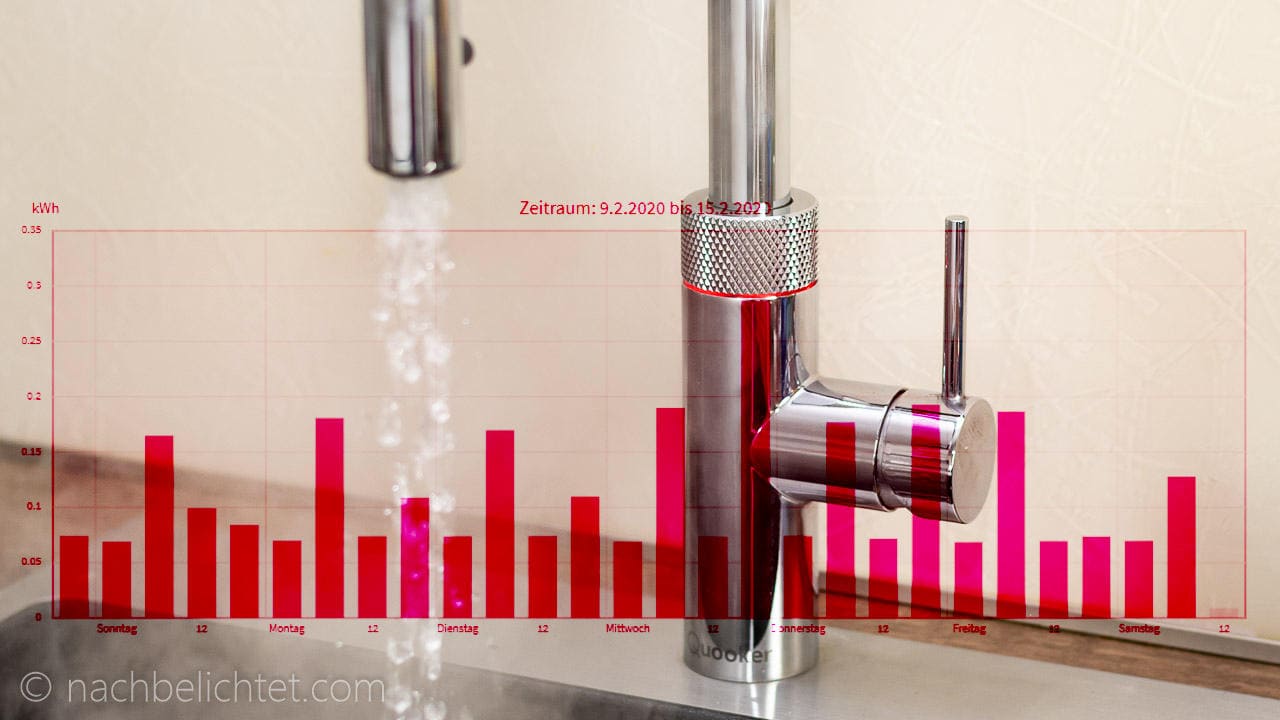
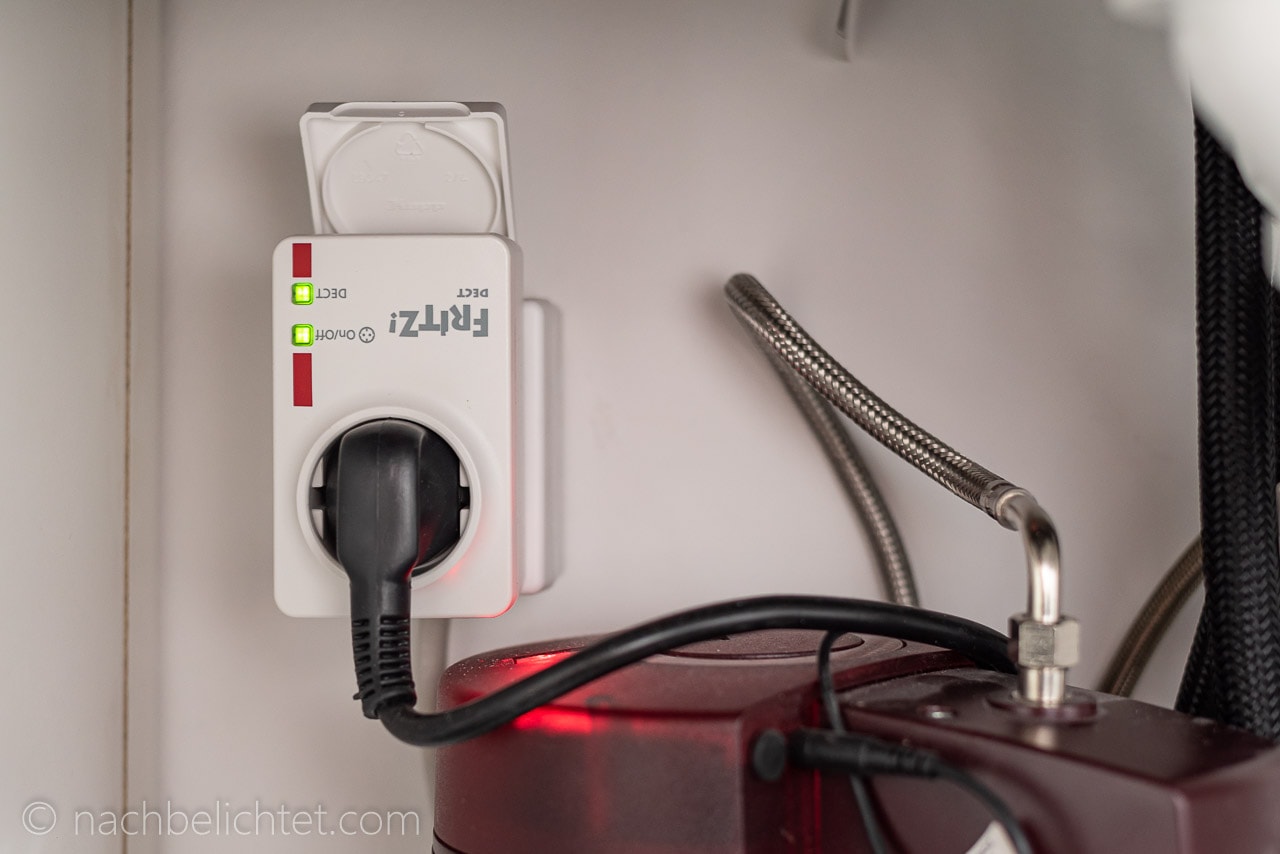
I recorded our typical consumption over 2 weeks. I used an AVM Fritz!DECT 200 socket with current measurement, which I simply connected between the Quooker and the socket. The AVM Fritz!DECT 200 records the power consumption amazingly accurately – I compared this with a professional measurement setup a long time ago. The Quooker heats up briefly about once every 25 minutes.
Our typical profile looks like this: around 7:30 in the morning, I use a good 1 litre of water for a thermos flask of tea. In the evening, we cook and I briefly rinse boards, knives etc. with the Quooker or use hot water for cooking. I also often have another cup of tea etc.
At the weekend we often cook very elaborate meals and for a few weeks now I’ve been baking bread on Saturdays. Here, too, I need hot water to remove the last remnants of the extremely sticky sourdough. During the week, no water is used during the day – unless we are on holiday.
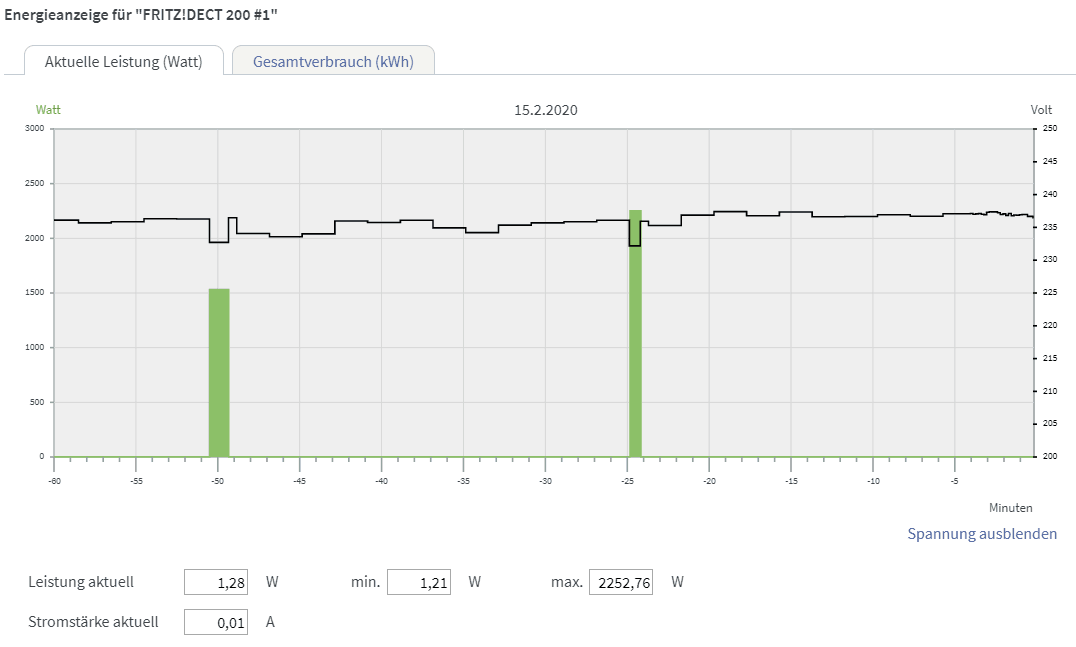
Quooker itself advertises with 5 ct. Electricity consumption per day. However, it is important to realise that this refers to holding the hot water, i.e. the standby consumption without tapping. If you draw a large quantity of boiling water from the Quooker, the reservoir has to be reheated and this naturally consumes more electricity than keeping the water hot. Quooker itself is unable to estimate your habits and therefore your hot water requirements.
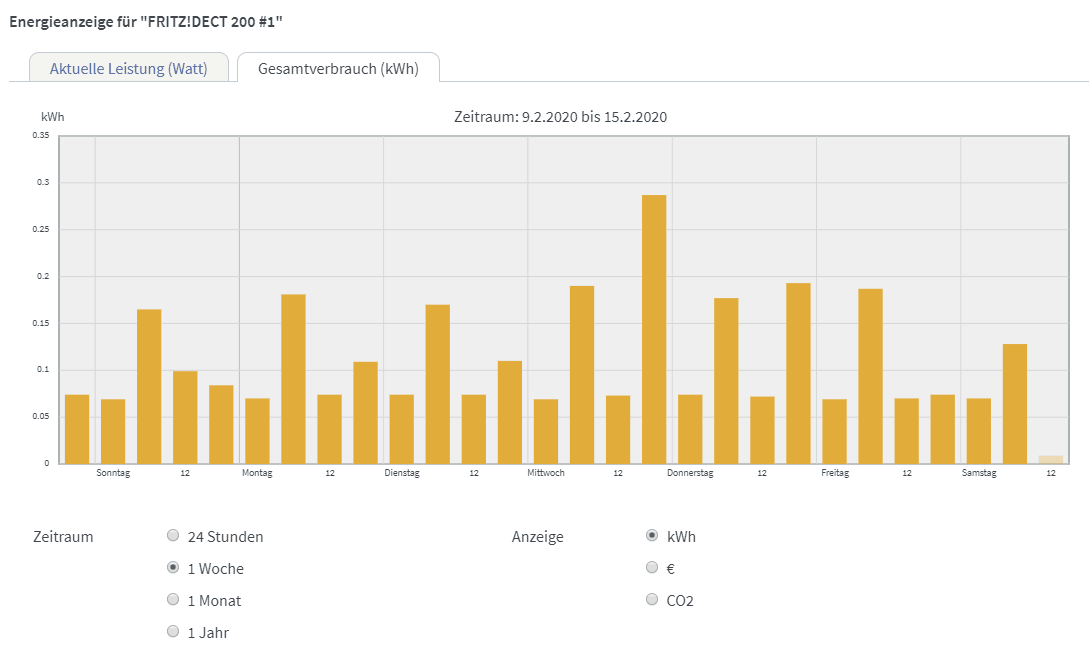
The standby consumption of the Quooker is actually around 7 cents per day (I have assumed our electricity price of 27.9 cents/kWh).
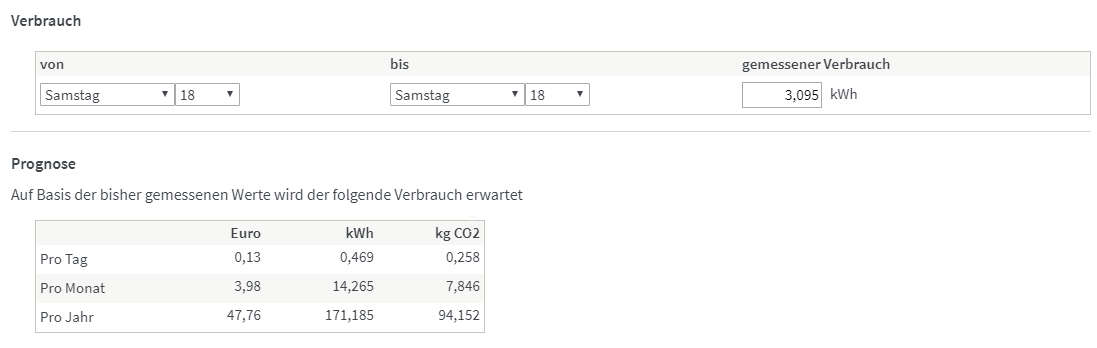
But now I’m interested in the consumption in practice and with the profile described above I get an average of 0.13 euros per day and 4 euros per month. That would be around 50 euros per year.
For comparison: a typical kettle with 2200 watts of power needs 3.5 minutes to boil one litre of water. We calculate: 2200 watts = 2.2 kW/60 = 0.0367 kWh per minute * 3.5 minutes = 0.129 kWh electricity consumption for 1 litre of water times 0.279 euros = 3.6 ct. per preparation. Assuming our typical hot water consumption (an average of around 2 litres per day), this works out at 7 cents per day compared to 0.13 euros with the Quooker. In return, you get the convenience of not having to wait for boiling water and always having it available.
UPDATE 16.03.2020
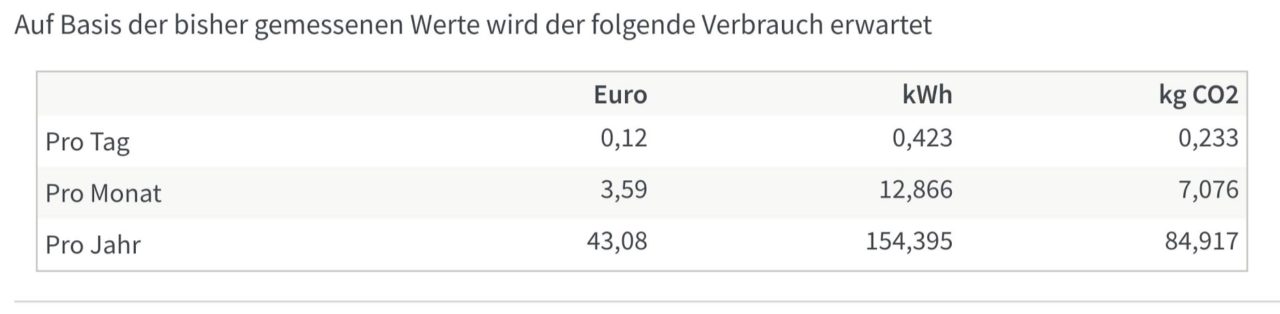
Another 4 weeks later, consumption is even lower. The monthly consumption costs of the Quooker are now around 3.60 euros.
Update 17.04.2020
And another 4 weeks later the measured values are confirmed
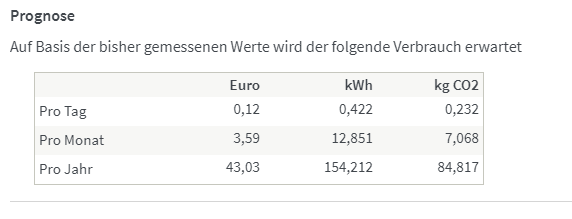
Conclusion:
The horror stories about the Quooker ‘s allegedly high energy requirements are far-fetched. We pay 13 cents a day for this convenience. With an electric kettle, we would be paying around 7 cents. Thanks to the good insulation, the Quooker works very efficiently and that’s worth it to us.
Heating water – an excursion into physics
A bit of physics is quite interesting if you want to know how much energy is needed to heat a litre of water to a certain temperature.
At the moment, the water in our house comes out of the tap at 9 °C. We live at 540 metres above sea level. Here the water already boils at 98.18 °C (the higher, the lower the boiling point). The 9 °C of the cold water can be subtracted from the 98 °C, leaving 89 Kelvin up to the boiling point, which must be supplied as external energy.
To heat 1 kilogram (1 litre) of water by 1 Kelvin, an energy of 4.183 kilojoules (the specific heat capacity of water) must be supplied.
4.18 kJ * 1 kg * 89 K = 372 kJ
1 Wh (watt hour) corresponds to 3.6 kilojoules
372 kJ / 3.6 = 103.3 Wh or 0.103 kWh (kilowatt hours)
0.103 kWh * 0.279 Euro per kilowatt hour of electricity = 0.029 Euro
In an ideal (physical) world, you would have to pay 3 ct. to heat a litre of water from 9 to 98 °C with electricity.
However, drinking water contains gases, minerals and other particles that increase the specific heat capacity compared to pure water. You therefore need a little more energy. The heating coil and the vessel must first be heated themselves, have a heat loss and the energy supplied is not 100 % converted into heat. All these losses are not taken into account in this calculation, so that under real conditions our kettle realistically requires 0.13 kWh instead of the ideal 0.1 kWh to heat the water. However, this also shows that we are definitely in the right ballpark with this calculation.
Letzte Aktualisierung am 2026-06-11 / Affiliate Links / Bilder von der Amazon Product Advertising API
Leave a Reply