
- Klark Teknik 76-KT – Hardware at a plug-in price
- Features
- How do you set up a 76-KT (or 1176)?
- The sound of the 76-KT vs. plugins
- Sound examples
- Distorted rock bass with extreme settings
- Acoustic guitar with light compression
- Drums – smashing
- Vocals – light compression for tracking
- TL;DR – Conclusion and evaluation
Due to moving into a new house and various other things, I haven’t made any music for over 1 1/2 years and my studio equipment was mothballed. Now I’m building my own small recording studio in the basement, I’ve got rid of some equipment and bought some new gear.

I’m an ITB (In the Box) mixer, so I mix almost entirely with software in the computer. When recording, however, I like to use a compressor and various preamps. I just like it when the sound is a bit more “complete” when it’s recorded. It also helps when recording if you get a processed sound on the headphones via direct monitoring and you save yourself problems with latency.

When I record electric guitars and basses, I use a splitter anyway and record the completely unprocessed signal of the instruments in addition to the microphones and preamps. This allows you to re-amp later if necessary or use it for amp simulations. Not only is this always on the safe side, it also opens up endless possibilities.
But I’ve also always used some compression and/or limiting for microphone recordings. This way of working simply comes from the past: I first got involved with recording a good 30 years ago. Back then, equipment was incredibly expensive and you recorded on 4 or 8-track tape machines or multitrack tape decks. In the end, there weren’t enough compressors, noise gates etc. for the mix, so you had to decide on a sound and a setting at the recording stage. However, this commitment also meant that work was much quicker.
Klark Teknik 76-KT – hardware at a plug-in price
The Urei 1176 is probably the most legendary studio compressor. That’s why there are so many clones and devices based on it. With the WA-76, Warm Audio was previously one of the most affordable providers, which was also said to have a very authentic sound.
With the Klark Teknik 76-KT, however, you now have another opportunity to get the 1176 sound in your home at the outrageous price of just 200 euros. Of course, this is only possible thanks to production in the Far East and an experienced parent company, namely the Music Group with the Behringer brand.
Back then, Behringer was the only equipment that was accessible and affordable for home recording and I still have an Autocom MDX 1200 compressor from back then and I don’t think it’s bad at all today. I had my first contact with an original Urei 1176 Blackface in 1993 at Delta Sound Studio in Wilster. I used it for my bass recordings back then.
Equipment
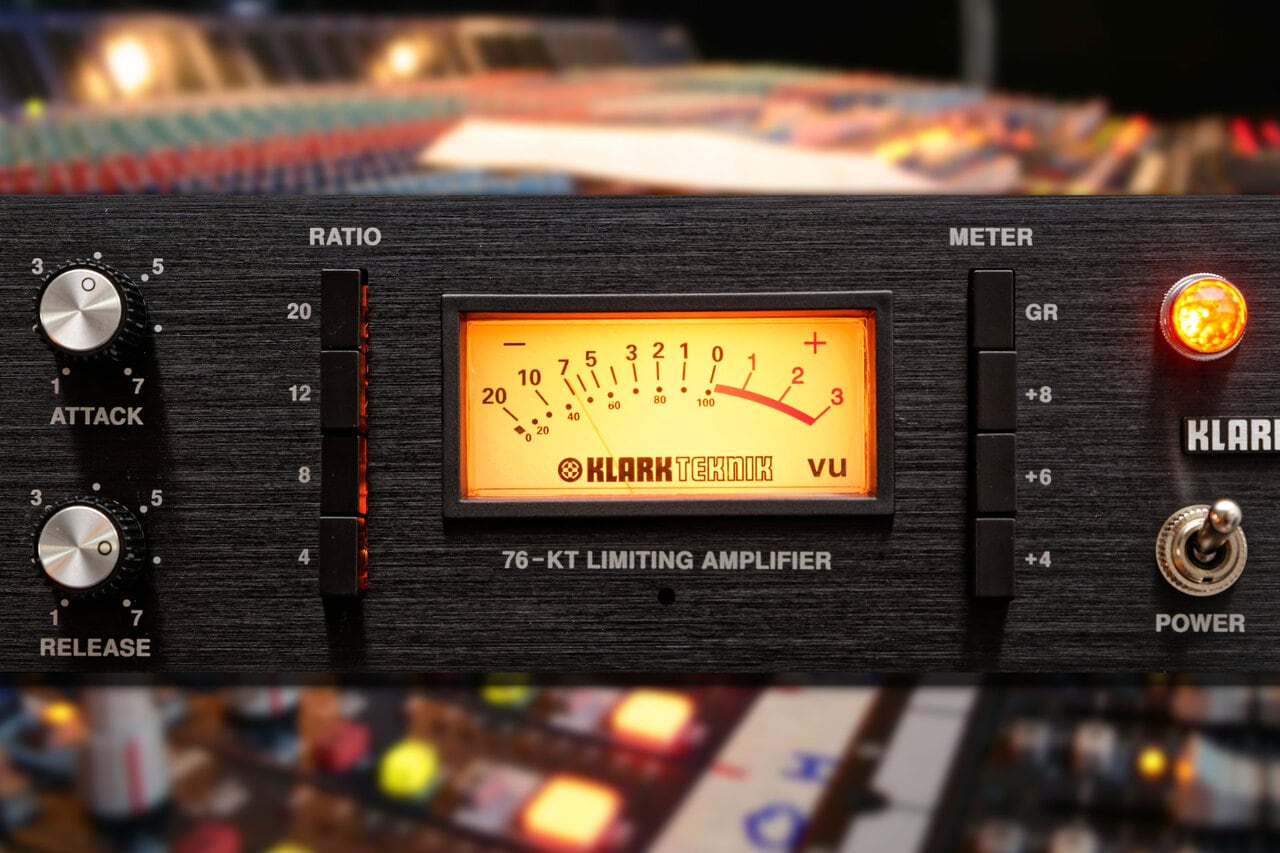
Back to the Klark Teknik 76-KT. Even visually, the model is clearly recognisable. Input and output levels, attack and release controls, the row of buttons for ratio and for displaying the prominent level meter. Transformer-balanced inputs and outputs on the rear panel and a small pad switch, which should be switched off for normal studio levels. A trim pot can be used to calibrate the level meter.

The large toggle switch on the front illuminates the classic operating display and the backlighting of the display instrument.
As with the original, the time constants are shorter the further you move the attack and release controls in a clockwise direction.
How do you set a 76-KT (or 1176)?
Even without compression, you get some colouration with the original, which is probably mostly due to the transformers. The 76-KT is no exception – assuming correct gain staging, the Klark Teknik also behaves pleasingly low-noise. Only in the last quarter of the output control do you hear more noise. In practice, however, even this is rarely a problem, unless you are dealing with very quiet sources such as concert guitars etc., but then there is usually something wrong with the gain staging.

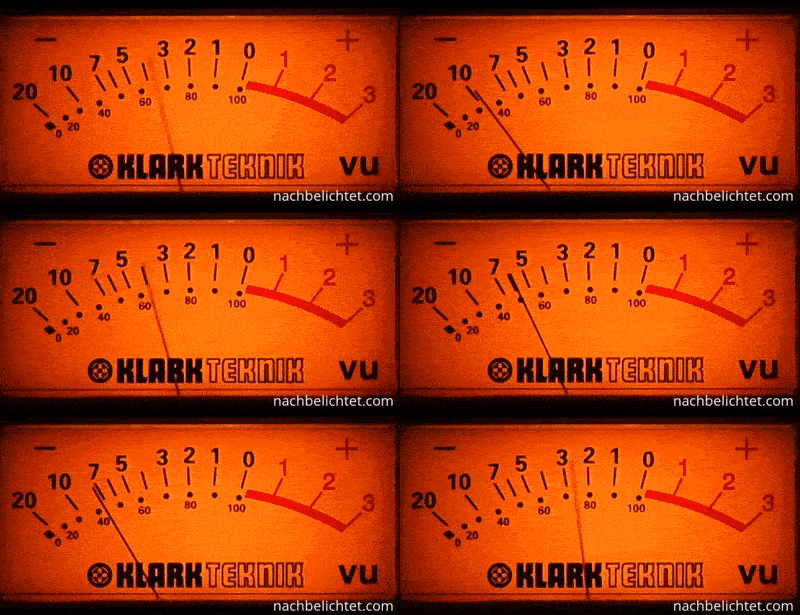
The very first test reveals how fast a Hardware 1176 or the Klark Teknik 76-KT is. 20 microseconds as the fastest attack time and 80 microseconds for the release are quite something and can be used to keep transients in check very effectively.
The usual procedure for setting an 1176 for effective but transparent limiting of strong transients during recording is as follows:
- Attack to the slowest value, i.e. control to the left.
- Release to the fastest value, i.e. control to the right.
- Metre setting to GR
- Ratio to 10:1 (20:1 is also not uncommon)
- Input to the right until a maximum reduction of 4-6 dB is displayed
- Now turn the attack control slowly to the right until the signal appears duller or lifeless, then back off a little, i.e. slower attack. With the 76-KT
- The release time is adapted to the material, suitable values are usually somewhere between 11 and 14 o’clock. You simply must not hear the compressor “pumping”
- Use the output controlto compensate for any level losses and adjust the level so that the interface receives a maximum of -12 to -10 dB.
Incidentally, this is not only a good starting point for the 76-KT and 1176, but also for many other compressors. This setting keeps peaks in bass, acoustic guitar (here rather 3-4 dB), but also vocals in check. At the same time, the 76-KT gives the signal a slight colouration.
The 76-KT always behaves very transparently and reliably with these settings. You should just make sure that the attack and release times are not too short, as this is difficult to fix later. Once the transients are gone, they are gone …
There is also the “Dr Pepper” rule. In the 1960s, the American soft drink manufacturer recommended drinking a Dr Pepper Coke at 10 o’clock, 2 o’clock and 4 o’clock in order to get a sugar boost. This became a basic setting for the 1176:
Attack at 10 o’clock, Release at 2 o’clock and Ratio at 4:1.
The sound of the 76-KT vs. plugins
I pitted the Klark Teknik 76-KT against some of my favourite plug-ins. First of all: the 76-KT is in a completely different league. This is particularly evident when it comes to extreme settings. If you turn the attack and release of the 76-KT (and 1176) all the way to the right, all buttons in, you get a very special distortion in addition to powerful compression, which is particularly good on bass recordings, but is also suitable for heavy vocals.
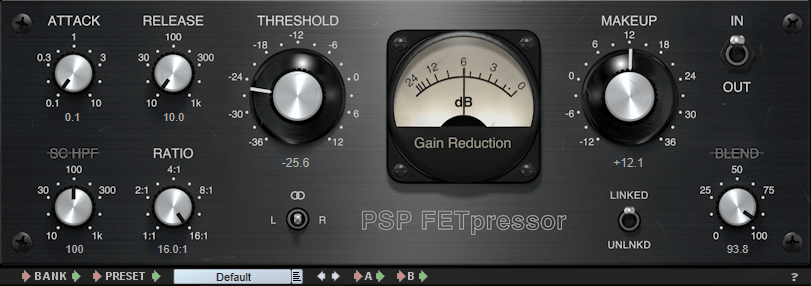
This sound cannot be realised at all or only partially with plug-ins based on the 1176. The PSP FETpressor, which I consider to be one of the best compressor plug-ins anyway, performed best here.
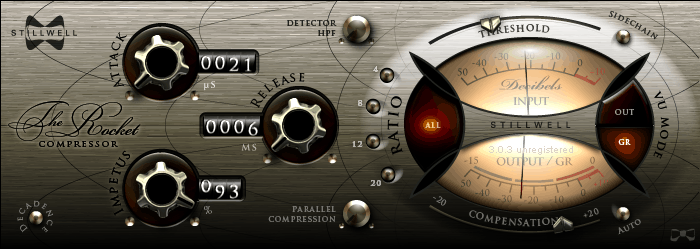
The Stillwell Rocket also performs damn well.
The furthest away from the hardware is the IK Multimedia Black 76 – but only at extreme settings.
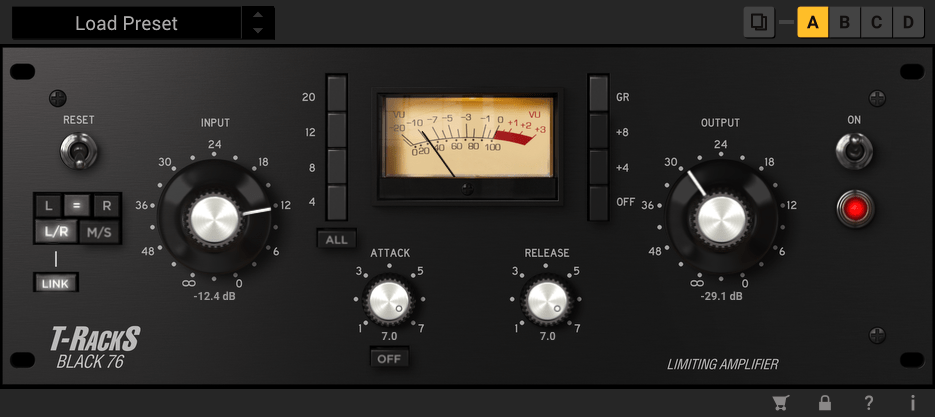
It sounds much darker, doesn’t have the fast attack times and can’t be persuaded to distort as mentioned above. In moderate settings, however, it clearly has the charm of the hardware.
Sound examples
I have recorded some sound examples for you and compared them with the plugins mentioned above. The aim is to show the similarities and differences. I have integrated the 76-KT into Reaper via Rea insert so that I can use it there like a software plugin and easily switch, compare and adjust between all the plugins.
Distorted rock bass with extreme settings
To create the distinctive distortion of the 1176 with extreme settings (attack and release to the right at the fastest setting, all-in), I tried to achieve a similar sound with all the plugins. It was not possible with the IK Black 76. A Yamaha BB-425 went into a SansAmp RBI and then directly into the MOTU 828 Mk III interface.
Acoustic guitar with light compression
I processed the acoustic guitar – a Recording King RD-06 – with light compression. The compressors were set to medium attack and release times (12 o’clock on the 76-KT), 4:1 compression and a level reduction of a good 3 db.
Drums – Smashing
With 20:1 ratio, attack 2 o’clock, release 10 o’clock, level reduction: up to 20 dB. The room part comes out nicely.
Vocals – light compression for tracking
The vocal track is by my long-time friend and singer Rainer Ludwig. For his considerable tonal and dynamic range, I chose a ratio of 8:1, attack 6, release 5 (i.e. relatively fast), with a level reduction of 6-7 dB.


Leave a Reply